
Data Overview
This infographic presents an overview of the training programs conducted in 2025, covering Democracy and Human Rights, Advanced Federalism, Rule of Law and Judicial Independence, Thuta Yatwon Book Club, and Local Education Board initiatives.
This infographic presents an overview of the training programs conducted in 2025, covering Democracy and Human Rights, Advanced Federalism, Rule of Law and Judicial Independence, Thuta Yatwon Book Club, and Local Education Board initiatives.
Total
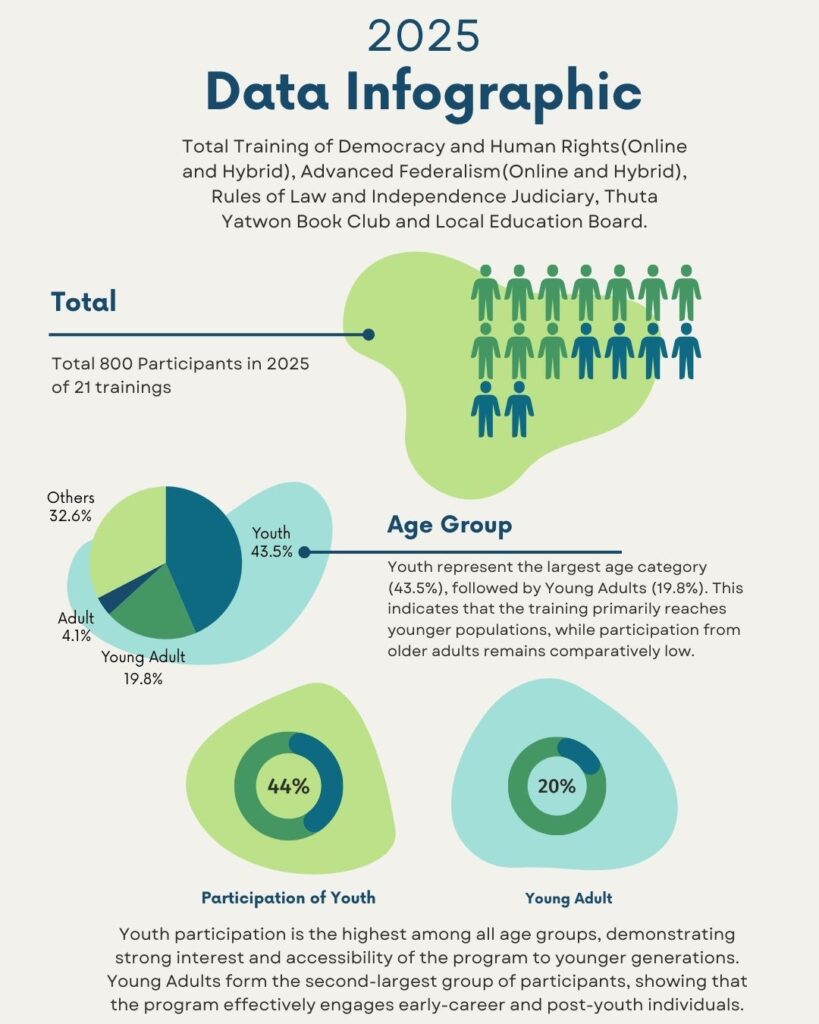
Throughout 2025, a total of 21 online and hybrid training sessions were organized, reaching 800 participants. These programs contributed to strengthening public awareness and capacity in democratic governance, human rights, and legal and educational frameworks.
Age Group Distribution
The age group analysis shows that youth represent the largest proportion of participants (43.5%), followed by young adults (19.8%) and adults (4.1%), while other age groups account for 32.6%. This distribution indicates that the training programs primarily engage younger populations, demonstrating high accessibility and strong interest among youth, while participation from older age groups remains comparatively limited. Youth participation accounts for 44% of total participants, making it the most represented age group. This reflects a strong demand among younger generations for knowledge related to democracy, human rights, and governance. Young adults, comprising 20% of participants, form the second-largest group, highlighting the programs’ effectiveness in engaging early-career individuals and those transitioning beyond youth.
Gender and Education Background Overview
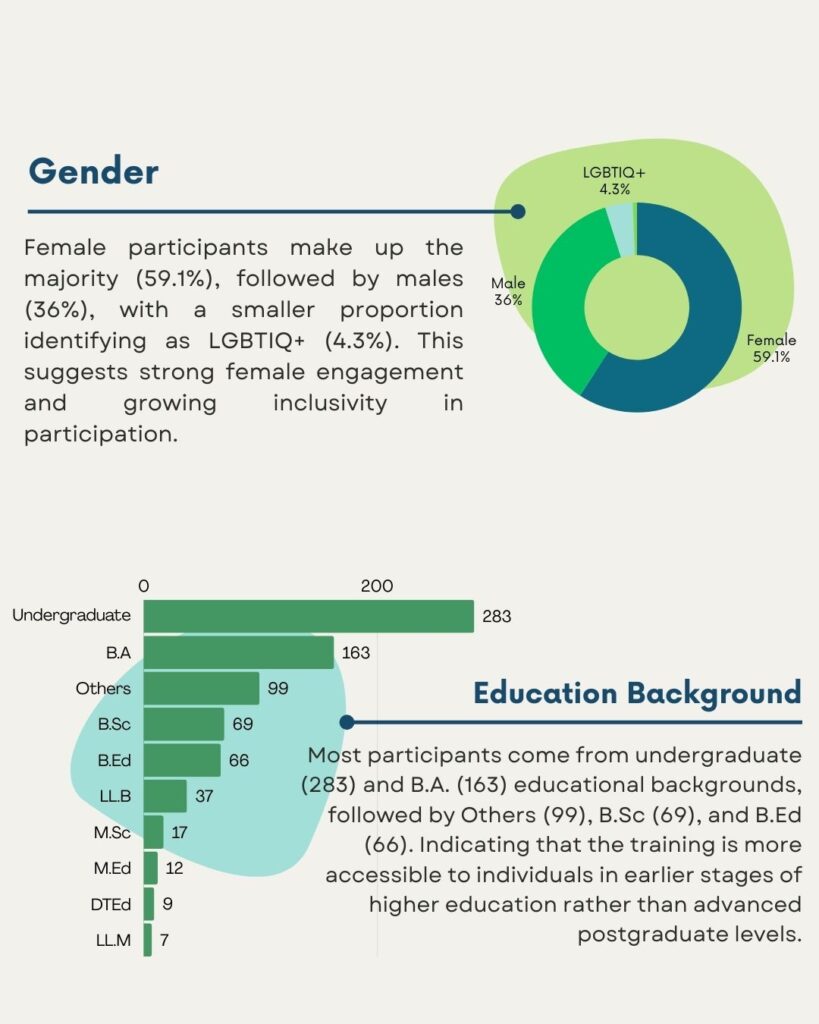
The gender distribution shows that female participants make up the majority (59.1%), followed by males (36%), while LGBTIQ+ participants account for 4.3%, reflecting strong female engagement and growing inclusivity.
In terms of education, most participants come from undergraduate (283) and B.A. (163) backgrounds. This is followed by other disciplines (99), B.Sc (69), and B.Ed (66), indicating that the training programs are more accessible to individuals in the earlier stages of higher education than at advanced postgraduate levels.
Regional Participation Overview
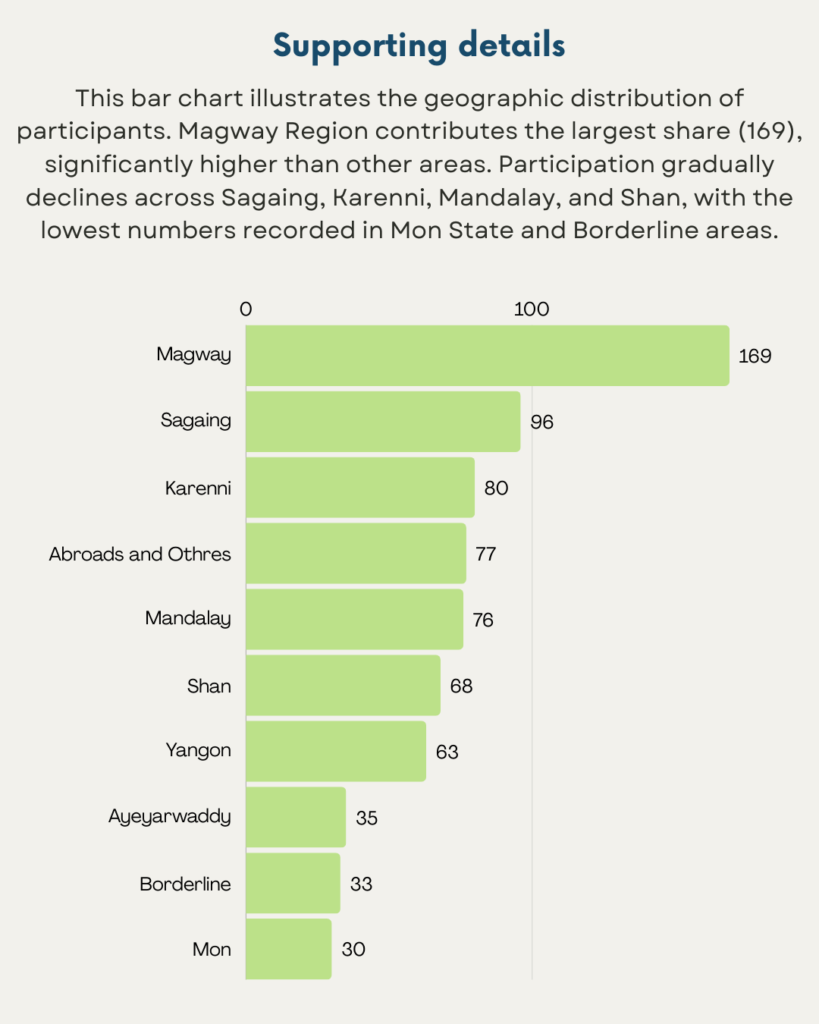
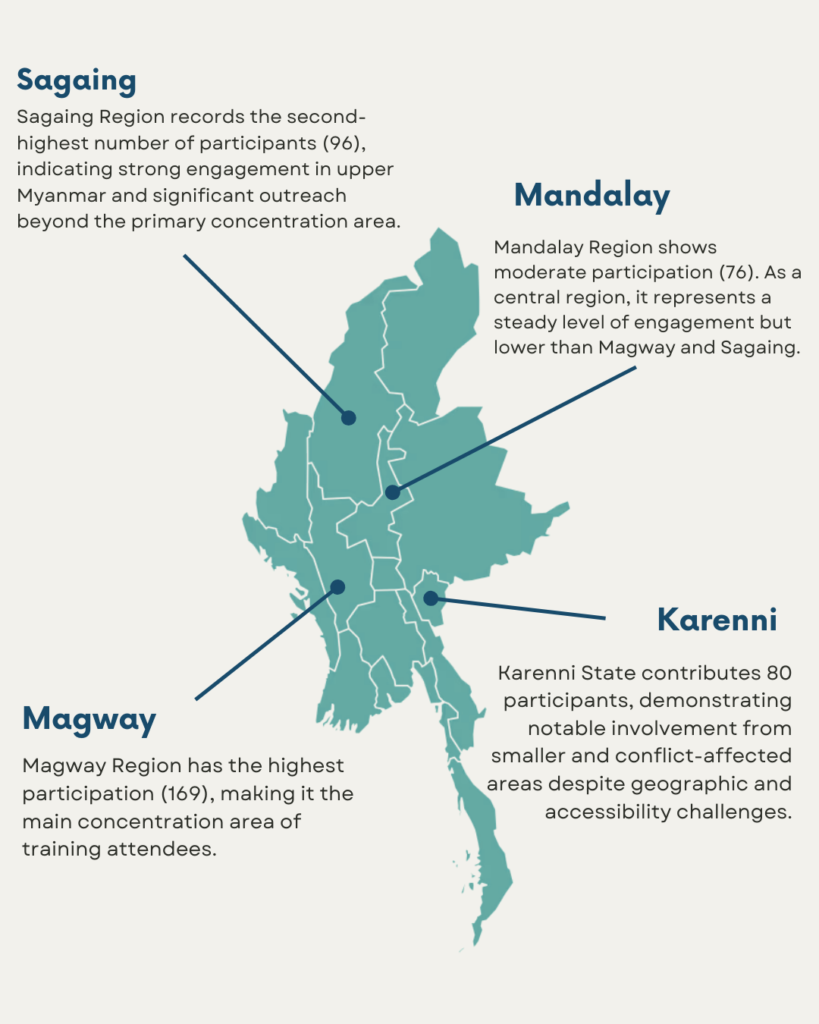
Participant distribution shows strong regional engagement across Myanmar. Magway Region records the highest participation with 169 participants, making it the primary concentration area for training activities. Sagaing Region follows with 96 participants, indicating strong outreach in upper Myanmar. Karenni State contributes 80 participants, demonstrating meaningful participation from smaller and conflict-affected areas despite geographic and accessibility challenges. Mandalay Region shows moderate participation with 76 participants, reflecting steady but comparatively lower engagement than Magway and Sagaing.
Supporting Details: Regional Distribution
This bar chart illustrates the geographic distribution of participants across regions. Magway Region records the highest participation (169 participants), significantly exceeding other areas. Participation gradually declines across Sagaing (96), Karenni (80), Mandalay (76), and Shan (68). Moderate engagement is also observed among participants from abroad and other areas (77). The lowest participation levels are recorded in Ayeyarwaddy (35), Borderline areas (33), and Mon State (30).