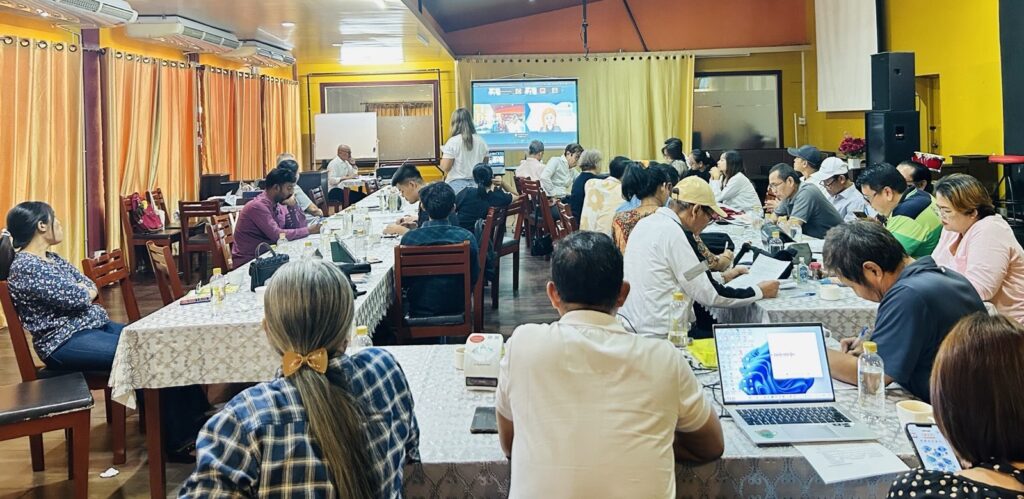
April 22, 2026 – The Institute for Peace and Social Justice (IPSJ) successfully concluded its five-day hybrid workshop, “Federal Dialogue Series No. 2/2026: Strengthening the Emerging Federal Units and The Way Forward,” held April 18–22, 2026. The event brought together key stakeholders, legislative representatives, and technical experts to navigate the complexities of building a federal democratic union in the current interim period.
The workshop served as a critical platform for 36 representatives from across Myanmar, including members of Federal Unit Parliaments and the Committee Representing State Hluttaws from Sagaing, Magway, Mandalay, Yangon, Ayeyarwady, Bago, Tanintharyi, Kachin, Kayah (Karenni), Chin, Mon, Rakhine, Kayin (Karen), and Shan.
The five-day agenda formulated by IPSJ was not merely a series of lectures; it was a carefully sequenced progression from macro-level constitutional theory to micro-level administrative execution, culminating in the complex dynamics of civil-military relations. Each day addressed a distinct pillar of state-building, with IPSJ’s roster of experts and selected panelists from the attending federal units facilitating the sessions.
Day 1: Interim Governance and Constitution-Making
The opening day laid the groundwork by addressing the mechanics of “Governance Practice in Interim Federal Units” and the progression of “Constitution-Making.” Panelists from all participating Units and States shared practical experiences on the delicate balancing act of managing state and local powers in environments where the central state has effectively collapsed. The afternoon sessions, guided by U Kyaw Kyaw, Dr. Thaung Htun, and U Khin Maung Win, confronted the existential strategic vision of the Spring Revolution.
Day 2: Division of Power and Legislative Oversight
Facilitated by U Khin Maung Win, the morning session focused extensively on the “Division of Powers Among Federal Agents.” The dialogue underscored that a proper, codified division of power is the primary structural safeguard against any single group’s domination of government agencies. Dr. Daisy Kris led the afternoon discourse on “Legislative Oversight and Accountability.” The revolution faces significant internal vulnerabilities related to transparency and corruption, particularly given the rapid proliferation of autonomous local defense groups and the establishment of parallel taxation systems. Establishing functional parliamentary oversight mechanisms, empowering legislative committees, and instituting rigorous budgetary transparency are not abstract democratic ideals; they are existential requirements for maintaining public trust.
Day 3: Local Governance Institutions (LGIs)
The third day of the workshop delivered some of the most profound, empirically grounded insights of the entire series, focusing on Local Governance Institutions (LGIs) and featuring a landmark case study on the bottom-up implementation of Local Education Boards (LEBs) across Sagaing, Magway, Mon, and Karenni. The discourse on LGIs, co-led by Dr. Daisy Kris and Dr. Thaung Htun, navigated the complex challenges of legitimizing local authorities amid an active armed conflict. Key theoretical and practical topics included debates over direct elections versus hybrid appointment models during the revolution, explicit power-sharing mandates for local governance across legislative, executive, and judicial functions, and the absolute imperative of inclusivity. Drawing on global LGI frameworks, the workshop highlighted that effective local governance must actively dismantle historical marginalization by ensuring the participation of women and ethnic minorities.
Day 4: Natural Resource Management and Fiscal Federalism
Resource extraction has historically served as both the primary prize and the primary fuel for Myanmar’s prolonged civil conflicts. Day 4, led by Dr. Kenton Linn and Dr. Thaung Htun, addressed the highly volatile intersection of Natural Resource Management—encompassing land, forestry, fisheries, mining, and oil and gas—and fiscal federalism. The presence of Dr. Kenton Linn as a facilitator was particularly strategic. Serving concurrently as the rotating chairperson of the Interim Chin National Consultative Council (ICNCC), Dr. Kenton has previously emphasized the dual, often competing objectives of advancing socio-economic progress in resistance-controlled areas while simultaneously safeguarding natural resources and protecting the environment. Similarly, Dr. Thaung Htun brings over a decade of high-level IPSJ advocacy focused on agricultural reform, sustainable community fisheries, and land rights.
Day 5: Defense Architecture and Civil-Military Relations
The final day of the workshop addressed the most operationally sensitive and existentially critical issue: the Role of Federal Units in Defense and Security Affairs, facilitated by Dr. Mie Mie Winn Byrd. As the revolution progresses and territory is captured, the rapid proliferation of armed actors necessitates a highly structured command hierarchy to prevent rogue activity, protect civilians, and maintain absolute civilian supremacy over the military. A significant portion of the discussion focused on the management of the local administrative and security apparatuses established by the NUG under the Ministries of Home Affairs and Immigration and of Defense. These interconnected entities are colloquially known across Myanmar by their Burmese acronyms as the “3 Ps”.
The Way Forward
Throughout the series, daily group discussions focused on “The Way Forward,” emphasizing bottom-up federalism as a counter-narrative to Balkanization. The dialogue underscored the importance of internal and external legitimacy for state actors and the need for a strategic vision to strengthen the ongoing revolution.
“This series is not just about theoretical frameworks; it is about the practical survival and success of our emerging federal units,” said IPSJ Executive Director Dr. Thaung Htun at the closing ceremony. “By convening a diverse group of representatives, we are ensuring that the future federal union is built on inclusive governance and mutual accountability.”