In 2025, the Institute for Peace and Social Justice (IPSJ) implemented Programs on Democracy and Human Rights, Just Transition, and Peace and Dialogue. The project emphasized capacity building, local ownership, policy engagement, and rights-based community empowerment.
The Democracy and Human Rights (DHR) course is a core training program regularly implemented by IPSJ to cultivate a shared vision and common values for a future democratic society in Burma. The course aims to strengthen participants’ understanding of democracy, human rights, federalism, local governance, and community empowerment, while enhancing political awareness and encouraging active civic engagement among youth.
Since April 2023, the DHR course has been delivered as a comprehensive 12-day module, primarily through online sessions facilitated by prominent experts. From 2025, IPSJ further expanded the program through a hybrid training model that combines online lectures with facilitated, in-person group learning. This hybrid approach was developed in consultation with local CDM educators in Magway and Sagaing Regions and Karenni State. The DHR Trainning cover the subjects:
- Politics, Democracy, Authoritarianism, and Citizenship
- Human Rights, Human Dignity, and Fundamental Rights
- Conceptual Frameworks and Practices of Local Governance
- Federalism and Its Relevance for Burma
- Comparative Democratization: Failed and Successful Transitions and Lessons for Myanmar
During FY 2025, the DHR training was conducted through four online sessions and two hybrid sessions:
| Democracy and Human Rights (DHR) training conducted in 2025 FY | ||||||
| Sr. | Description | Period/ Location | Trainee | |||
| Male | Female | *Other | Total | |||
| DHR (Online) | ||||||
| 1. | DHR Training, Batch I-2025 | Jan 14-26, 2025 | 08 | 20 | 02 | 30 |
| 2. | DHR Batch II-2025 | Feb 14-27, 2025 | 12 | 15 | 3 | 30 |
| 3 | DHR Batch III-2025 | Nov 1-15, 2025 | 13 | 11 | 4 | 28 |
| 4. | DHR Batch IV-2025 | Dec 1-17, 2025 | 11 | 25 | 2 | 38 |
| Total | 44 | 71 | 10 | 126 | ||
| DHR (Hybrid) | ||||||
| 1. | DHR Training, Batch I-2025 (Hybrid) | Feb 28 – Mar 11, 2025, Nan Man Village, Mese Township Karenni State | 8 | 14 | 0 | 22 |
| 2. | DHR Training, Batch II-2025 (Hybrid) | May 4-15, 2025 Nan Man Village, Mese Township Karenni State | 8 | 22 | 2 | 32 |
| 3. | DHR Coaching Session for Hybrid | August 11-15, 2025 | ||||
| 4. | DHR Training, Batch III-2025 (Hybrid) | August 19-29, Pakokku Township Magway Region | 21 | |||
| Total 16 38 2 75 | ||||||
Democracy & Human Rights Online Training
The 12-day online DHR training, conducted in four sessions in 2025, was attended by an average of 126 participants, including political activists, civil society leaders, Civil Disobedience Movement (CDM) government employees, students, university lecturers, and ethnic youth.
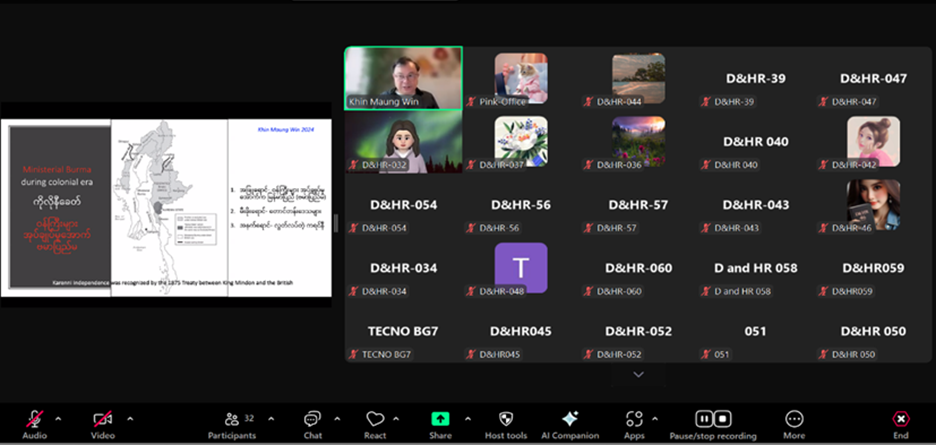
Fig.1: U Khin Maung Win, giving a lecture on “Why Does Burma Need to Practice Federalism” during DHR Batch II 2025.
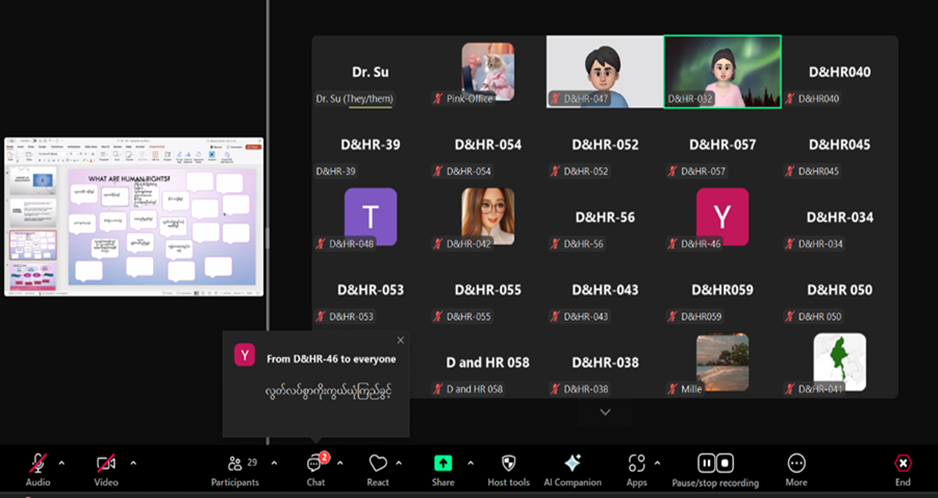
Fig. 1; Dr. Su Yin Htun, giving a lecture on “Human Rights” during DHR Batch II 2025
Democracy & Human Rights Hybrid Training
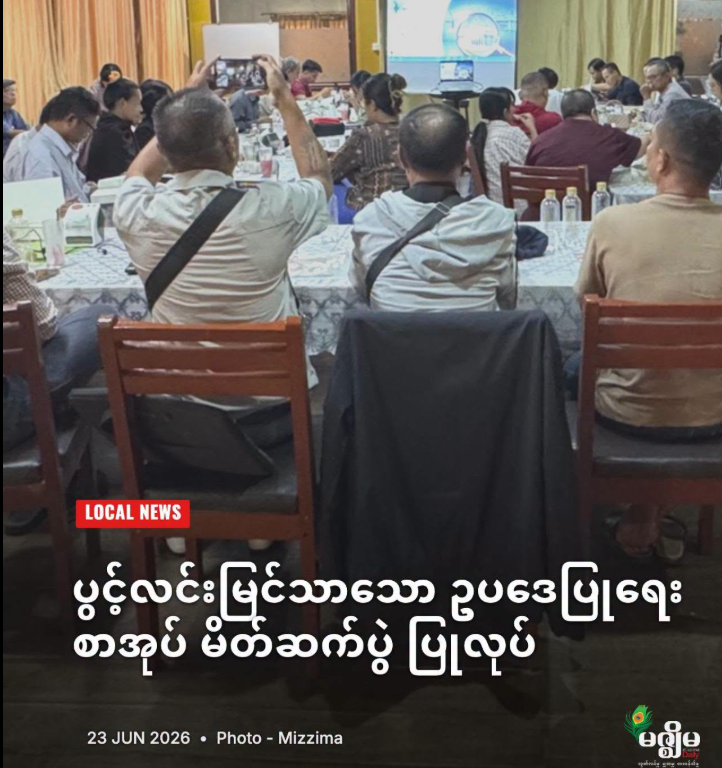
The project implemented a conflict-sensitive, hybrid Democracy and Human Rights (DHR) training program combining secure online instruction (via Zoom) with locally led, small-group, in-person facilitation. Designed to operate under conditions of active conflict, movement restrictions, and limited connectivity, the hybrid model enabled continued civic education while minimizing security risks and strengthening local ownership. The approach was piloted and implemented in 2025 in partnership with trusted local organizations across conflict-affected areas of Myanmar.
The program was implemented in two sequential stages: (1) a Coaching Session to build localized facilitation capacity, followed by (2) decentralized Hybrid DHR Trainings delivered at the community level.
Coaching Session: Building Local Facilitation Capacity: The Coaching Session focused on developing a cadre of trained facilitators capable of delivering DHR training in conflict-affected and hard-to-reach areas where direct IPSJ access was limited. A selected group of IPSJ alumni—primarily active participants in IPSJ Book Club discussions—were trained to support facilitation, logistics coordination, and community mobilization at the local level.
The Coaching Session was delivered in two phases.
Phase I: It combined structured self-learning with interactive live sessions to strengthen foundational knowledge of democracy, human rights, federalism, and local governance, while enhancing facilitation and instructional skills. Civil Disobedience Movement (CDM) teachers participated as designated training supporters.
Phase II: It provided advanced coaching focused on practical facilitation techniques, contextual adaptation, and preparation for decentralized implementation in conflict-affected settings.
Together, the Coaching Sessions strengthened local facilitation capacity, reduced operational risks, and ensured program continuity and contextual relevance across target areas.
Democracy & Human Rights Hybrid Training
(Magway Region)
Building on the enhanced facilitation capacities developed through the Coaching Sessions, IPSJ implemented a 12-day Hybrid Democracy and Human Rights (DHR) Training Program in a camp-based format in the Magway Region in late August 2025. The training is among the earliest documented applications of a hybrid DHR model in a conflict-affected mainland context in Myanmar, demonstrating the feasibility of delivering structured civic education under severe security and mobility constraints.
The program engaged 21 trainees and nine trained facilitators and volunteers, with participants drawn primarily from youth and CDM staff in dry-zone areas of Magway Region. Subject-matter experts delivered core modules through secure online platforms, while trained local facilitators provided continuous in-person support to ensure learning continuity, contextual relevance, and participant safety.
Facilitators led daily recap sessions, moderated small-group discussions on sensitive political and governance issues—including the Panglong Agreement, political roadmaps, ethnic relations, and local governance challenges—and supported monitoring and evaluation through pre- and post-tests and structured participant feedback.
Democracy & Human Rights Hybrid Training
Karenni State
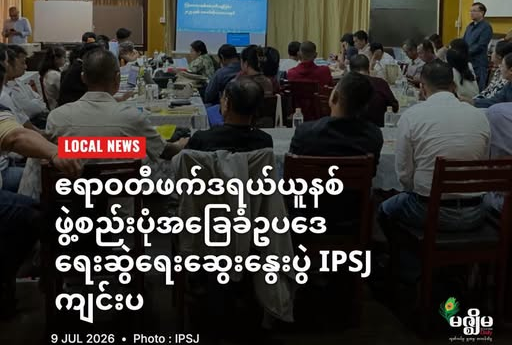
In Karenni State, IPSJ conducted two sessions of the Hybrid Democracy and Human Rights (DHR) Training Program in partnership with the Karenni National Youth Organization (KNYO), using a camp-based and conflict-sensitive approach. Each session accommodated approximately 25 trainees and was supported by four trained volunteers.
The training was jointly organized by IPSJ and KNYO, with KNYO leading all on-the-ground implementation. Responsibilities included facilitating group discussions, coordinating daily activities, leading evening reading sessions, and administering pre- and post-tests and evaluation tools. This locally led model strengthened trust, ensured contextual relevance, enhanced participant safety, and reinforced local ownership.
Participant recruitment was also managed by KNYO through its established community networks and alumni of previous IPSJ trainings. An open call for applications was disseminated across liberated townships and IDP camps, prioritizing female participation, geographic diversity, and the inclusion of conflict-affected youth, including displaced persons and members of community-based organizations.
The training was held at Nan Man Village Hall in Mae Se Township, Bawlakhe District, with temporary accommodation arranged through community-based hosting to minimize visibility and security risks. The program was officially opened by representatives of the Interim Karenni State Administration Council, Mae Se Township officials, and Nan Man Village authorities, reinforcing local legitimacy and coordination.
The 12-day program combined approximately three hours of daily online instruction with three hours of in-person, facilitator-led discussions, ensuring flexibility, security, and meaningful participant engagement.


Fig 1; Under the Hybrid program, lectures were delivered via Zoom while participants gathered in an on-site hall. [Twenty-two Karenni youth completed the Hybrid Democracy and Human Rights Training Batch I].


Fig 2; Lectures were delivered via the Zoom platform while participants gathered in a hall on-site as part of the Hybrid DHR Training Program


Fig 3; Group discussion among participants were an essential component of the hybrid program.
In response to Myanmar’s evolving political context, IPSJ has adopted an adaptive implementation strategy grounded in local partnerships, decentralized community-based activities, and incremental, context-sensitive objectives. In newly liberated areas, including Karenni State, local communities are increasingly filling governance gaps left by the military regime but often lack the capacity to ensure inclusive and accountable governance. IPSJ addresses this challenge by integrating governance into civic education, strengthening grassroots leadership through training in federalism, local governance, and the rule of law, promoting cooperative federalism, and applying hybrid learning models. Together with the expansion of Democracy and Human Rights (DHR) training in Ethnic Revolutionary Organization (ERO) areas, these efforts empower communities to plan, participate, and advocate effectively, thereby extending IPSJ’s reach and impact.