October 18, 2026
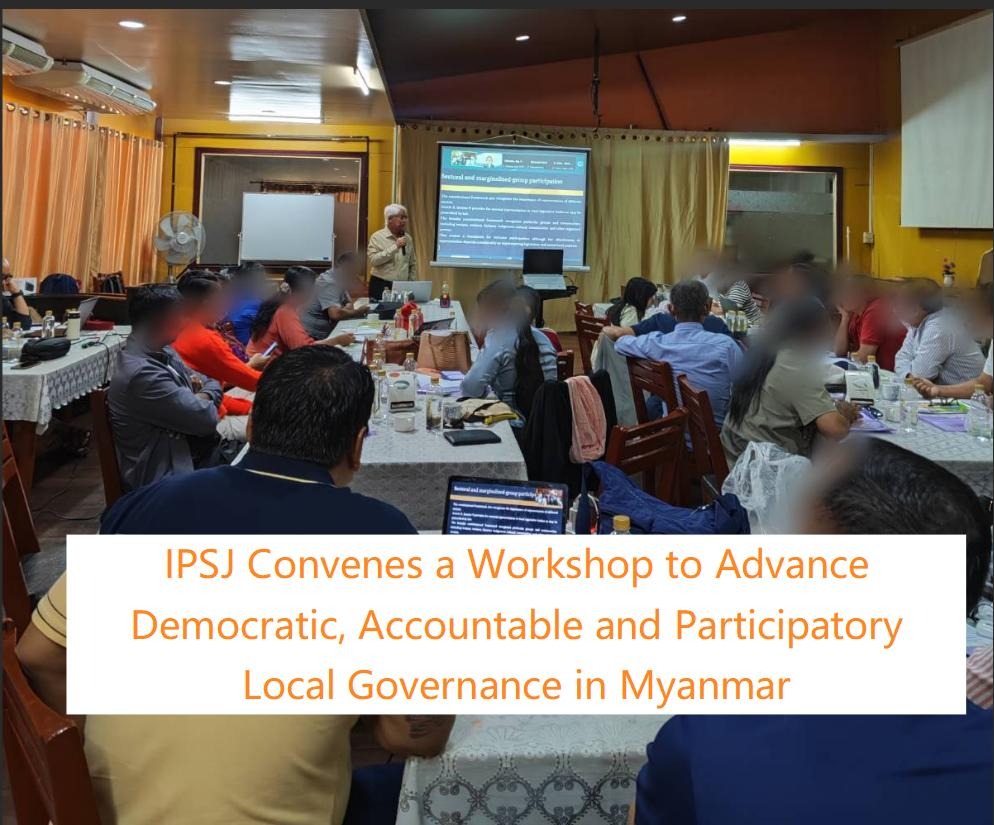
From October 14 to 16, 2026, the Karenni Interim Executive Council (IEC) hosted a landmark three-day capacity-building workshop titled “Federal Democratic Civilian Oversight and Security Sector Governance: From International Models to Local Action Planning.2 The event, sponsored by Myanmar-Women Peace and Security (M-WPS) and facilitated by Dr. Miemie Winn Byrd, U Kyaw Kyaw, and U Khin Maung Win of the Institute for Peace and Social Justice (IPSJ), brought together 23 targeted representatives from the IEC’s Departments of Defense, Home Affairs, Justice, and Women and Children.
The workshop was convened to support the operationalization of the Karenni State Interim Arrangement (KSIA), a de facto constitutional framework that established an inclusive governance system following the 2021 military coup. A primary objective was to deepen participants’ understanding of civil-military relations, referral pathways, and civilian-led governance structures.
To achieve this, participants analyzed successful supranational and federal models to inform local structural reforms. Drawing on the United States military model, facilitators emphasized the necessity of separating civilian direction—which retains absolute authority over strategic policy, budgets, and deployment—from operational military command.
The curriculum also examined the North Atlantic Treaty Organization (NATO) and the European Union (EU) to explore coalition integration. By studying the EU’s bifurcated Common Security and Defense Policy (CSDP) structure, the IEC established a framework that empowers the Department of the Interior with autonomous civilian policing and stabilization capabilities (mirroring the EU’s CPCC) and enables the Department of Defense to focus exclusively on military operations against the junta (mirroring the MPCC).
Recognizing that structural transitions require robust interpersonal foundations, the workshop integrated advanced conflict-management frameworks. Leaders were trained in Stephen M. R. Covey’s “Speed of Trust” and the Harvard Negotiation Project’s “Five Core Concerns” (Appreciation, Affiliation, Autonomy, Status, and Role) to build institutional trust, navigate interdepartmental resource allocation, and foster collaborative governance.
A critical mandate of the summit was to prevent Conflict-Related Sexual Violence (CRSV) and Gender-Based Violence (GBV) through structural and operational measures. The Department of Women and Children, alongside the Department of Justice, was tasked with embedding survivor-centered protection mechanisms, implementing safe reporting procedures, and ensuring independent prosecutorial capabilities that comply with international standards for transitional justice.
The workshop culminated in the collaborative development of a comprehensive 90-day reform plan. This strategic roadmap mandates a coordinated interagency effort: the Department of Defense will formalize civilian supremacy and withdraw from domestic law enforcement; the Department of the Home Affairs will rapidly establish a civilian-led constabulary; the Department of Women and Children will integrate gender parity and protections across local administrations; and the Department of Justice will operationalize independent accountability mechanisms for all security sector personnel, regardless of rank or factional affiliation.